The Sales Coaching Agent.
A pre-packaged Claude agent you download from Blueprint's GitHub and set up against your own HubSpot and call-recording system. It walks you through the setup step by step, then reviews your deals on a regular cadence — comparing what's documented in the CRM against what actually happened in the conversations — and suggests specific coaching actions for each open deal. Available to all portfolio companies — reach out to us for access.
A sales manager agent that (mostly) sets itself up.
Deployable in a couple of hours, the Sales Coaching Agent ships as a repository you download: a step-by-step runbook, three Claude skills, the scoring rubrics, and the supporting scripts. You connect it to your own HubSpot and call-recording data — nothing leaves your systems, and there's no new vendor or subscription. The runbook walks you (or us, working with you) through every step.
What you need
HubSpot CRM with deals, emails, and call recordings in one place · a Mac that can leave Claude Code running · a Google Drive folder where reports get delivered.
What the setup covers
Connecting HubSpot and Drive, installing the skills and scripts, tuning the rubric language to your sales motion, a supervised first run, and scheduling the recurring cadence.
What you get (examples)
Anonymized deliverables from the pilot engagement — click any preview to open the full PDF.
Two capabilities, one methodology.
Both capabilities score deals against a rubric of selling behaviors, and both require verbatim evidence from emails, transcripts, and notes for every score — so the output reflects the work that was actually done, not just the fields that were filled in.
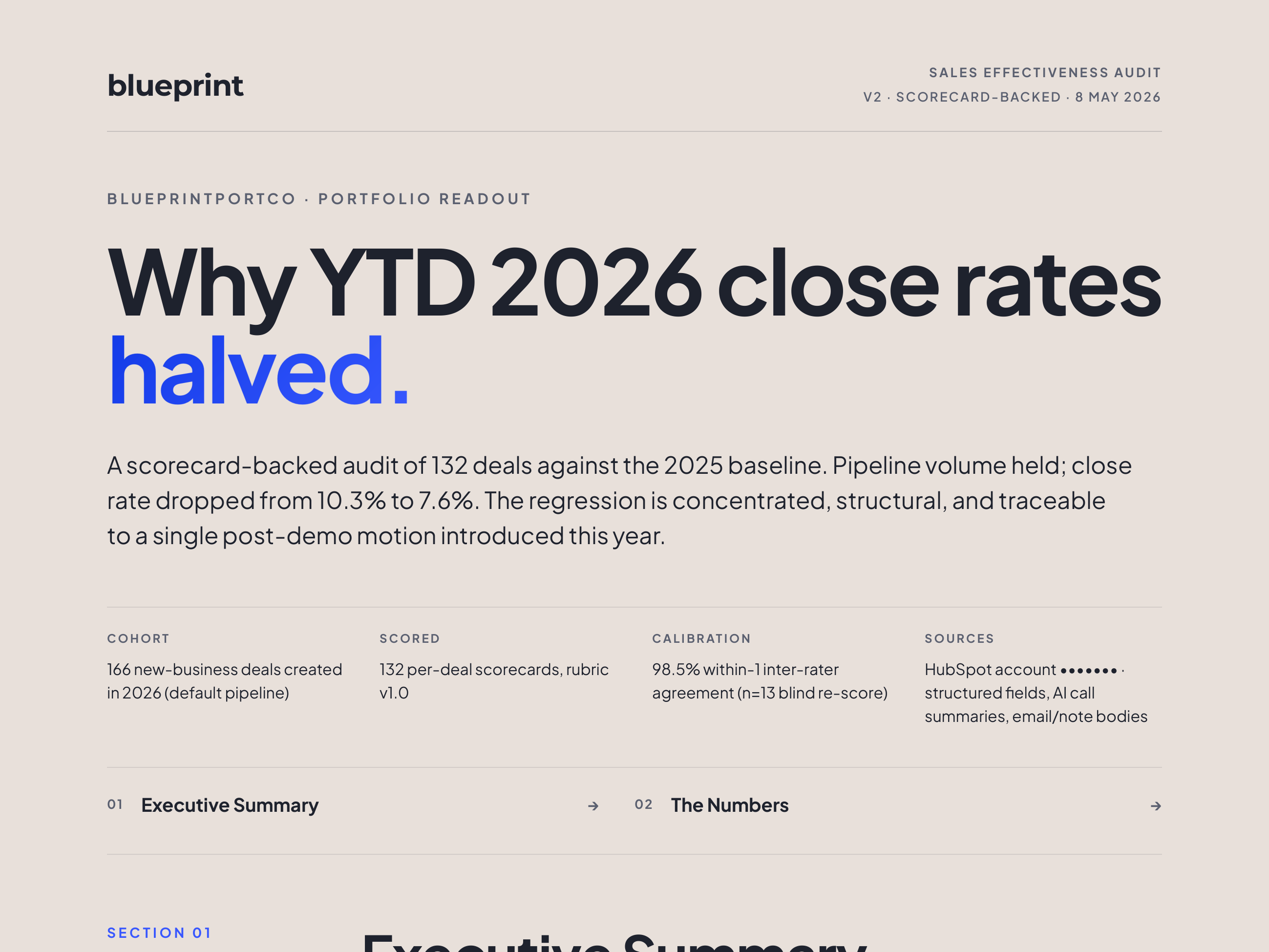
The Sales Effectiveness Audit
A retrospective review of your closed deals, scored across 10 dimensions — six quality (discovery depth, objection handling, stakeholder engagement…) and four strategy (pricing-tier discipline, next-step commitment, multi-threading…). The output is an executive brief on which behaviors correlate with winning in your data, and where documented work diverges from the CRM record. Useful as a one-time baseline before turning on the recurring agent.
The Sales Manager Agent
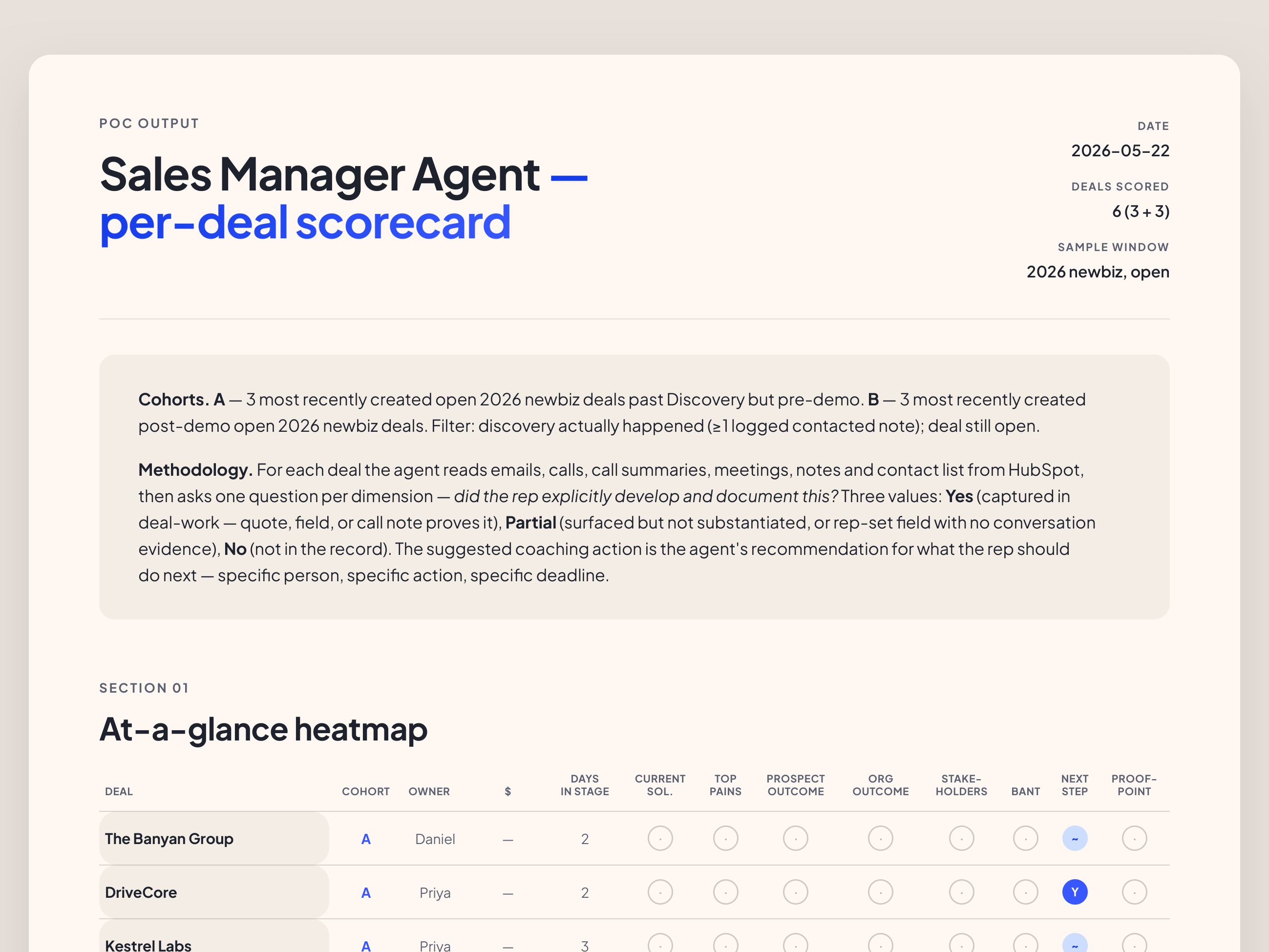
A recurring review of your open deals, scored on 8 coaching dimensions — current solution, pains, prospect outcome, org outcome, stakeholders, BANT, next step, and proof-point. Runs on a schedule you set (the default is Monday and Thursday nights, with a Friday week-over-week progress report). Each deal gets a specific suggested coaching action: who to contact, what to ask, and when to move on.
What it surfaced at one portfolio company.
Pilot engagement · full-year cohort of 132 closed dealsWe ran the audit at one of our portfolio companies before standing up the recurring agent. A few of the findings, to give a sense of what this kind of review can surface:
Field data vs. conversation evidence
The competitor-intel field was populated on 97.5% of deals; conversation evidence supported it on 14%. The gap between the two turned out to be a useful coaching signal in itself.
Multi-threading correlated with winning
Post-demo deals with one engaged contact won 3.3% of the time; deals with three or more engaged stakeholders won 33.3%.
Larger deals, different motion
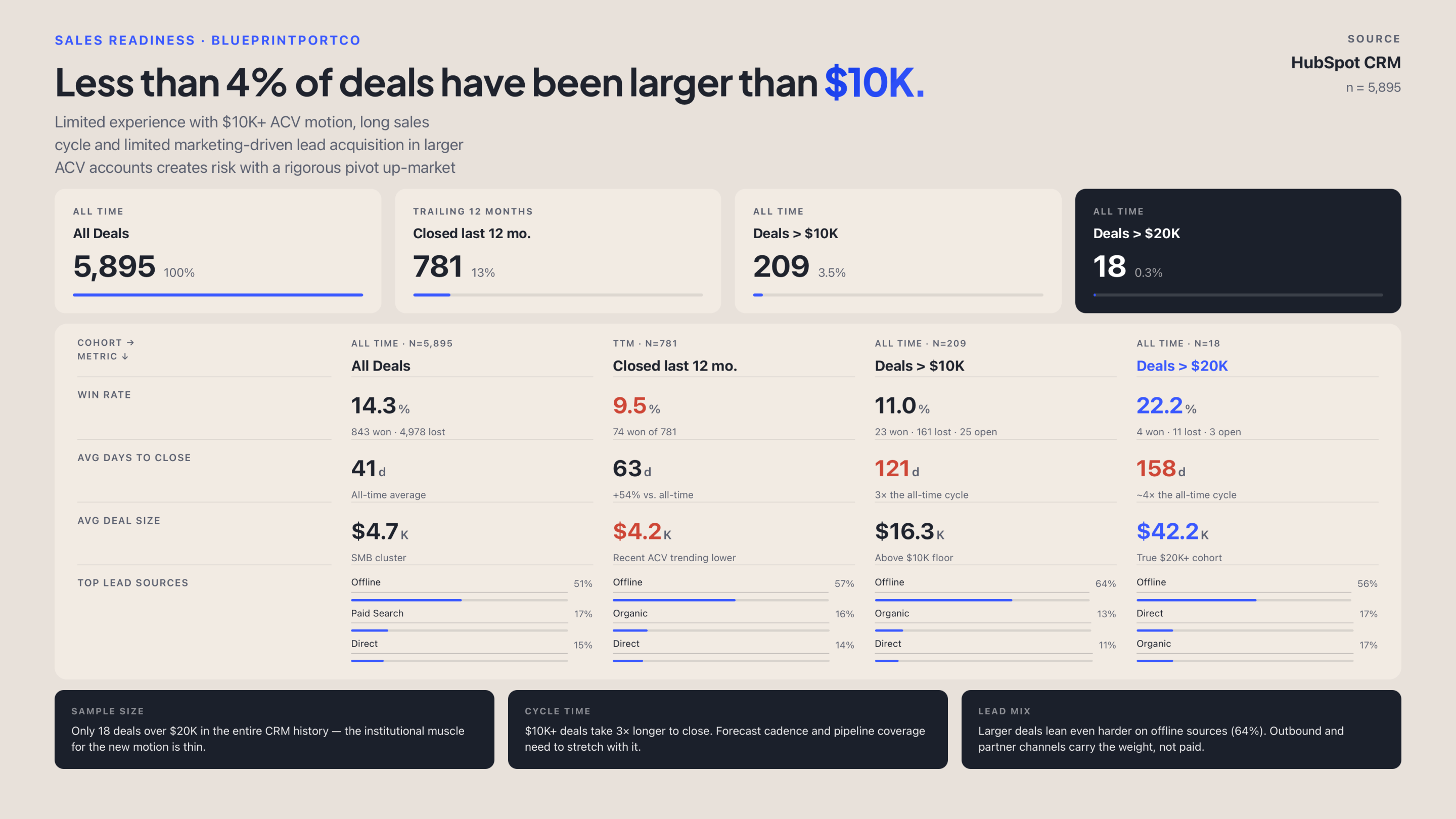
Deals above $7.5K ACV grew 2.8× year over year while their win rate declined from 17.2% to 8.6% — pointing to a segment that needed its own playbook.
These are one company's numbers, not benchmarks. The point of the audit is to find the patterns in your data — the dimensions, thresholds, and coaching priorities will differ by team and motion.
What a run looks like.
Each run scores every open deal on the 8 dimensions — Yes, Partial, or No, with the supporting evidence — and produces a heatmap plus one suggested coaching action per deal. The excerpt below is from a real run at the pilot company, anonymized.
| Deal | Stage | $ | Current Sol. | Pains | Outcome | Stakeholders | BANT | Next Step | Proof-Point |
|---|---|---|---|---|---|---|---|---|---|
| Deal 1 | Demo Scheduled | — | · | · | · | · | · | ~ | · |
| Deal 2 | Demo Scheduled | — | · | · | · | · | · | Y | · |
| Deal 3 | In Review | $15,750 | Y | Y | ~ | Y | ~ | · | · |
| Deal 4 | In Review | $11,000 | Y | ~ | ~ | ~ | ~ | Y | · |
| Deal 5 | Demo Completed | $8,500 | ~ | · | · | ~ | · | · | · |
Legend: Y = documented with evidence · ~ = partial · · = not yet documented. Deal 3 illustrates the kind of read the heatmap gives a manager: seven people attended the demo and the pain is well documented, but there's no agreed proof-point and no next meeting on the calendar — a useful prompt for the next 1:1.
The suggested actions are specific to each deal
Deal 3 — agree on a proof-point
“Email both stakeholders by EOD Friday: given your current tool doesn't track activities the way you need, what's the single workflow you'd need to see working live to make the case to leadership? Book 30 minutes for exactly that, and narrow the proposal to one recommended package.”
Deal 5 — change the channel or close the loop
“Three follow-ups since the demo with no reply. One final move: reach the second decision-maker the prospect named, plus a closing-the-loop email. If no reply by Friday, mark closed-lost and revisit on the prospect's timeline.”
Delivered to a Drive folder on a schedule.
Every run lands in a dated Google Drive folder automatically. The Friday run adds a week-over-week progress report showing which dimensions improved, which deals advanced, and where documentation slipped.
- Scored CSV — every open deal, all 8 dimensions, the supporting evidence, and the suggested coaching action. The authoritative record.
- Branded PDF report — the readable version for pipeline reviews.
- Color-coded XLSX — the heatmap as a spreadsheet.
- Friday progress report — week-over-week movement across reps and deals.
Available to the portfolio.
The package is in a private repository available to all Blueprint portfolio companies: the 11-step runbook, three Claude skills, six supporting scripts, the complete rubric set, and scheduled-task templates. Reach out to the Build Team and we'll share access and work through the setup with you — including tuning the rubric language to your sales motion.
If you want a sense of what the system would say about your team before committing to the recurring agent, start with the audit on a recent cohort of closed deals. It takes about a week, requires nothing from your reps, and produces the baseline the coaching agent then works against.